About this episode
A year after Sheikh Hasina's regime fell, I sat down with Arif Rahman for the POST's "Beyond Binary" series to take stock. The conversation ranged from what the July uprising actually was (a war's final battle, not a movement), to why BNP is preparing for a dignified death, to why Bangladesh's entire geopolitical relevance rests on underwear manufacturing and peacekeeping troops. And why did the Vichy-like Awami government fall? Because they triumphed in bridge-making, while their statementship declined.
I was cautiously pessimistic throughout, which the host noted was unusual. I stand by it. Ad-dahru yawmān: yawmun laka wa-yawmun ʿalayk ...
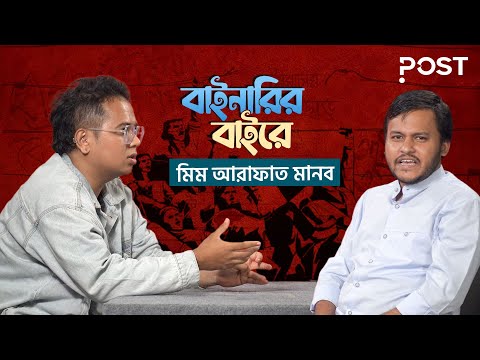
Click to play. Video in Bengali.
Selected Quotes
"I don't consider July a movement. I don't consider it a revolution either. My observation is that Bangladesh has seen three major wars. One was 1971. One ran roughly from 1986 to 2013. And one ran from 2015 to 2024. July is the final battle of that last war — the last movement of a ten-year conflict. July was not a movement. July was a war that was ending."
"I feel like depression in Bangladesh has decreased. People were living in fatalism — like Diderot's Jacques the Fatalist. They had accepted that this is how life is. You knew who to call if something went wrong. You knew the whole hierarchy: below every minister, above everyone, Sheikh Hasina, and above her, no one. That hierarchy is gone. People are more open to more possibilities."
"Bangladesh is the world's biggest underwear factory. Besides underwear, Bangladesh has no significant contribution to the global economy. We export three things: brains, military peacekeeping forces, and underwear. That is why the world cares about us. Myanmar is already at war. If Bangladesh's other neighbour also goes to war, what does Bangladesh do — sandwiched between two conflicts? That is something I am deeply worried about."
"BNP is a metaphorically obese, immobile, dying party. They don't know how to do the things they need to do. The generation that voted most in July — that generation is the one that will vote most in the next election. If BNP continues to play it safe, at most they get through this election. My prediction is BNP's popularity will fall sharply before the next one. They are not marching with new people, with the new generation."
"Awami League was nothing but a giant mafia network spread across the whole country. You knew who to call to get someone beaten. You knew who to call to get out of trouble. That entire structure created a society of political depression. We have come out of it. Now we don't know what comes next."
"For Bangladesh to have good politics, politicians, bureaucrats, and the military need to come to a single understanding: we will not buy each other with money. If that doesn't happen, I don't believe any constitutional amendment can change Bangladesh's context. If corruption can't be stopped, I don't see a good long-term future for Bangladesh."
"The only thing Awami League did better than BNP was selling the Liberation War. Selling the Liberation War has no policy connection whatsoever. And I am very sorry to say this — but what did the Liberation War do for the women of Bangladesh? Did women see unlimited progress after 1971? What is 71's thesis on women? On the LGBT community? I don't find any feminist stance inside 71. Women lost a lot. What did they gain? Whatever women gained in Bangladesh came much later, from the economy — BRAC came in, NGOs came in. What the NGOs did for Bangladeshi women, no government actually did."
Related work
- the POST Interview — "Does BNP know where it's heading?" (October 2025) — a follow-up conversation on the same themes.
- From Mass Lynching to Mass Execution: Mobocratic Bangladesh — co-authored with Manjurul Mahmud Dhrubo, Netra News, October 2024.
Episode Details
- Date: July 2025
- Venue: the POST POSTCAST
- Series: Beyond Binary
- Host: Arif Rahman
- Language: Bengali
About the researcher
Meem Arafat Manab is a Marie Skłodowska-Curie Doctoral Fellow at Universidad Politécnica de Madrid and a former lecturer, activist, and student politician from Dhaka.
Full Profile